


Philosophy
I would like to show my philosophy through the naming of the Flower concept first, then the Mission Statement of my own-established coach school.
I named the model Flower because the origin of the name is the most profound reflection of the concept’s motivation, its theoretical background, and my professional value system. The symbol of Flower comes from a sentence in the movie The Last Samurai: “Every flower is perfect.” (Katsumoto’s last recognition) As a coach and a supervisor, I believe that as every flower is perfect, every system is perfect.
Besides, I believe that the following mission statement says a lot about my philosophy as well: “The main mission of the Academy of Applied Coaching is to provide quality coach training, to give new coaches a perspective, and through them, support everyone else in making their world a better place.” (Academy of Applied Coaching, Mission Statement, 2019)
The Flower model is particularly useful: • When there is no significant change for the client and the coach is frustrated. • When the coach feels stuck or struggles. • When the coach would like to clarify their thinking and feelings. • When the coach feels that the relationship with the client has become intimate. • When the coach feels unidentified issues in the room. • When conversations are repeated without significant progress. • When the coach feels something important is missing in the conversation. • “When the coach feels there is a moment (or longer) of disconnect in the conversation but can’t pin down what was occurring” (Clutterbuck 2008). • When the coach feels challenged with reflection-in-action. • When we would like to clarify the boundaries between thinking and feeling.
The reason why I made this concept is to help coaches explore their blocks and obstacles, although I know that they have tried to explore these before alone, in their self-reflections. The petals of the Flower give the opportunity to explore the different fields of thinking and the level of thinking separately or together, as the session brings. If we can explore deeply the different fields, we can get a very broad perspective of the whole work of the coach, the struggles, and give the opportunity to look at these obstacles from a distance. Perhaps from this distance they can handle their situation better.
Purpose
The purpose of The Flower conception is to give a simple and transparent perspective to the supervisor for conducting supervising sessions. Although I aimed for logic, simplicity and usability, I kept in mind the expectations of the supervision profession, which distinguishes the model from a coaching technique. I will describe the history of this model, consider the key elements, besides the potential pitfalls when this model is used.
The theory of the Flower is based on Gestalt psychology. Within this, the perceptual experiences that Max Wertheimer dealt with. Linked to this is this concept, which also shows the practicality of the theory. In addition, I believe that real insight can only be gained when the small parts come together to form a big whole, but my observations are that this process can be affected by a myriad of distortions in both the coaching and supervision process.
Starting from Gestalt, Cognitive Psychology is the second theoretical background on which I base my study. I believe that the mind is a system for storing, processing and using information, and that its functioning is closely linked to mental representations (observations), schemas, stereotypes, perception, memory, thinking and attention, which we can also work with effectively during sessions.
The brain is the control center of the human nervous system, whose nerve cells form an electrical network. How it works is as follows. It gathers information from the external and internal environment. This information and physical signals are converted by the brain into processable signals, but at this point a question arises: is it real? Because information is subject to processing distortions. After it is processed, it makes connections and takes actions that are appropriate for survival. Linked to this electrical network is the phenomenon of recognition. Following true recognition, the repetition of previous patterns of thought and behavior becomes impossible because the electrical pathway on which the information has traveled is burnt out. New thoughts build new pathways. This is why I think it’s important to work with the client deeply enough, but not at a therapeutic level.
Cognitive Psychology leads to Phenomenological Psychology, which explores the worldview and self-image of the individual, with a focus on the importance of individual choice and self-actualization. I would highlight here the importance of Carl Rogers’ concepts of empathy and self-awareness.
Finally, Positive Psychology, which is the main driver of my work, for the following idea. It says clinical psychology focuses too much on illness. Positive psychology says the goal is to maintain mental health, nurture talent and maintain a normal life.
These thoughts led to the creation of the Perception-Detection funnel in coaching. I show it here briefly as well, because this is both the theoretical background and the center of the Flower.
By ‘perception’ I mean the biological process of sensing. By ‘detection’ I mean the subjective quality experienced by the individual.
The 5 steps of the funnel concept are: • We perceive events • We detect, i.e. we associate emotions with it • Interpretation – the emotions trigger the unconscious, the schemas • We make decisions motivated by the messages of the unconscious • We act – these actions influence our further perceptions.
The Key Elements of the Flower Model
The model consists of five areas of potential focus which can be useful to both supervisor and supervisee to raise awareness of the processing, develop self-reflection, and be profound in conducting sessions.
The center of the model is the Perception-Detection funnel whose role is to raise awareness of our thinking process and remind us of the thinking distortions. Besides helping us to simplify the use of the petals. For instance, my frequent observation is that examining what happens on the level of facts could lead the client to recognize.
Although the petals are not meant to be applied sequentially, I suggest maintaining a logical connection during use to maintain the dynamic of the session.
This model outlines and discusses a practical framework for the system of the coach, the coachee and the supervisor; the relationships and interactions of the coach and coachee, the coach and supervisor and the coachee and others. We examine the awareness of the coach and supervisor, including preparatory thinking, interventions, self-reflections, learning and actions.
This breadth of perspective enables the coach to explore themselves and their relationships as a whole. Each of these petals has an important role to play in the nature and the effectiveness of the coaching conversation to develop both the coach and the client’s approach in the learning dialogue and the learning relationship. Besides, we also focus attention on the thoughts and behaviors of both parties in the coaching relationship.
The coaches frequently feel stuck because the coaching relationship is not working properly or they do not feel quality presence during the session. When thoughts of the client trigger something in the unconscious mind of the coach, this could take control out of their hands. This could cause remorse for the coach, which can hurt their professional self-esteem. Luckily, they have a clear understanding of what went wrong. If we can reveal the unconscious conversations that either they or the client were having internally before and during the formal coaching session, we can connect it with the level of facts in the parties’ lives. Interestingly, this information rarely meets with each other, which leads the coach to recognize that they are involved and it is rewarding to ask for some help.
The Flower model has seemed to be a practical tool because of its structure which leads us to the deeper level of the coach. It is flexible for revealing the coach-coachee-supervisor awareness and feelings. It deepens the learning process.
My observation is that it also shifts the emphasis of reflection and analysis away from the inner perspectives to the level of facts and towards the facts that reveal the unconscious messages we need to work with in supervision.
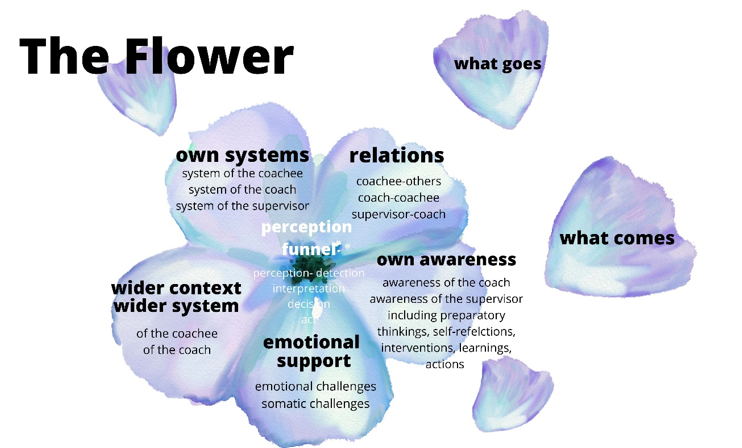
The Process of the Flower
Before exploring the model of the Flower of supervision in a supervision session, it is critically important to establish a mutual contract for both the supervisory relationship in general as well as each specific session. “At the beginning of each supervisory conversation it is essential to explore collaboratively the supervisory work that most needs to be attended to, and the outcomes required for the coach, the clients, the wider stakeholders and the profession. This helps the supervisor anchor the session in both supervisor and supervisee being in partnership both facing the key challenges that life is presenting.”
At this point my questions are the following: • What would you like to focus on today? • What outcome would you be happy with? How will I know if the session has achieved its purpose?
On one hand, it is important to listen carefully to the contracting because it illuminates the perspectives and aspects and to listen for the verbal and non-verbal expressions and metaphors to clarify the details of the Perception-detection funnel.
On the other hand, I found the most practical and useful that it is not me who summarizes the words of the coach, but them. I ask them to describe the aim in maximum 3 words. In this case, the opportunity for misunderstanding about the aim is minimal. Besides, this shortened version of the aim helps the coach to keep it in focus during the session, thinking about it collectively.
Shortly after we identify the aim of the session and clarify the goals, we ask the coach to talk about the situation in as much detail as they can and try to reveal every important moment. We examine the situation with the perception-detection funnel first. According to my observation, where the coach usually talks about the details is somewhere between the levels of detection and the interpretations. After this, we start to talk about information that does not come naturally. It is worth going down the funnel from top to bottom. If we are on the level of detection, I will ask:
• 3rd level: How did you interpret what happened? • 4th level: Did you make decisions based on your observations? What decisions did you make based on your observations? • 5th level: What will you do?
Then I go back on this with the common repeat through to the 1st level, what has not been mentioned so far.
• 5th level: Could you please repeat what you intend to do exactly? • 4th level: Could you tell me again what decision led you to make the steps mentioned earlier? • 3rd level: What kind of understanding helped you to make the decisions mentioned earlier? • 2nd level: How does the issue in question sound that brought you to this supervision session? • 1st level: How would this issue sound if we were just talking about the facts?
Both in coaching and supervision, choosing how deeply to attend to observations from each of the levels, and whether to draw the client’s attention to them, requires a combination of intuition and tacit knowledge.
If I sense that they are avoiding reflecting on one of the conversations, I voice what I am feeling and invite them to consider what they want to do with that piece of information. Sometimes they acknowledge the avoidance and change.
I have observed that an analysis of the verbal content would be useful, some additional questions come into play. In the diagram of The Flower model I mark it with a petal, with the label “what comes.” For example: • What words or phrases captured your attention then? • How clear is this feeling or the causes of this feeling in your mind?
The Center of the Flower
The Flower model is built on more complementary systems which are symbolized by the petals. As indicated in the Figure: • The first petal is one’s own systems, • The second petal is one’s own awareness, • The third petal is about the relationships, • The fourth petal is about feelings, • The fifth is the wider contexts.
Petal 1: One’s Own Systems
One’s own system helps us to understand what drives the coach, the client and the supervisor as well. How they present and frame the issues. This ‘brings the client into the room.’
The supervisor’s job at this petal is to help the coach return to what actually happened in the session with the coachee – what they said, what they saw, what they heard, what happened at the boundaries of their time with the coachee, upon their arrival and exit – and to try and separate these from their preconceptions and interpretations. If we work efficiently, we can collect useful facts-based information about the coachee and their system as well.
My typical petal 1 interventions include: • How do you think about the client at first sight and in the first 5 minutes of the session? • What did you see, hear and feel during the session? • What were the contracts about? Between coachee and organization, between coach and coachee
Petal 2: The Relationships
The second petal is about the relationship between coach and coachee, coach and supervisor, and the coachee and others.
The center of petal 2 is the relationship that the coach and the coachee are co-creating together, but we should examine the other two kinds of relationships mentioned above for the whole picture. Although, primarily, we want to have the coach reflect on the relationship with the coachee, in petal 2, it is important as well to examine the relationships that key stakeholders have with the coachee. We try to reveal parallels with the coaching relationships being discussed.
The coachee and their world includes their thoughts, feelings, relationships and activities. At this point the focus shifts from the coach’s world to attend to the conscious and unconscious relational field co-created in the coaching.
The aim of supervision is to help the coach to stand outside the relationship that they are part of. The new perspective gives new insight, which gives new experience. Furthermore, these answers can paint a credible picture; these questions are an indicator of what is probably already happening in the relationship.
We might ask: • If you could not speak and had to draw a picture about your relationship with the client to give me a clear picture about it, what would it look like? • What do we notice is going on in how we work together?
If the focus of the coaching is about the relationship of the coachee and their manager, the supervisor could ask: • From what you have heard and understand from the client, what does their relationship with their manager remind you of? • From what you have heard and understand from the client, if the coachee and their manager were stranded on a desert island, what would happen?
Frequently, we can notice similarities between the supervisor–coach relationship and the relationship between the coach and the client.
“This ‘parallel process’ includes both the conscious aspects (which include the feelings) of how they are relating as well as the unconscious feelings and ways of relating that have been absorbed from the coachee system (Hawkins and Shohet 2006; Hawkins and Smith 2006). The coach can therefore unwittingly treat the supervisor in the same way that their coachee treated them or, indeed, demonstrate the way in which the coachee engaged them, by engaging the supervisor in the same way.”
When the supervisor succeeds, they can help build a bridge between the conscious understanding of the coaching relationship and the emotional impact on the coach.
In petal 2, a supervisor can initiate a co-inquiry, like: I notice that when you talk about this client I feel some stress and anxiety/ we start talking more quickly, and I wonder how this connects to the coaching relationship. When do you encounter these feelings in the coaching relationship?
Petal 3: One’s Own Awareness
Petal 3 examines the awareness of the coach and supervisor during their session, including preparatory thinking, self-reflections, interventions, learnings and actions.
In coaching, this could mean significant difference in the quality if we mentally prepare the session. Besides, preparatory thinking helps us to process those feelings and thoughts that are caused by both the last session and the next one.
Although the second part of the self-awareness is the self-reflection, this may be the most important. The reason it takes place here is because preparatory thinking precedes self-reflection in order.
Both the coach and the supervisor can discover the unconscious content related to the coaching relationship by attending to their own feelings and thoughts while they listen to the presentation of the coachee or coach situation. Self-reflection presumes an existing relationship with the coach. Those thoughts and feelings that catch the attention during the session require practicing self-reflection from the coach and supervisor.
For efficient self-reflection I developed my own self-reflection model which I call self-reflection journal writing. It is based on the functioning of Broca’s and Wernicke’s areas in our brain and works through handwriting.
After quality preparatory thinking and proper self-reflection our interventions can be more effective and profound as well. Both the coach’s and supervisor’s interventions are about how they attend to each stage of the process and make interventions to help the progress.
Focusing on the supervisor now, for instance, they can voice their awareness to help the coach reflect. For example, I can say: • I feel some sadness and helplessness listening to the situation. Could these feelings connect to the situation? How could these feelings connect to the situation? • How could we work with the interest or intent behind the mentioned dilemma?
Finally, the learnings and understandings that compel us to apply in the future and help us change our functioning. Additionally, it is the actions that complete and demonstrate the learning progress in practice.
Petal 4: Emotional Support
Petal 4 concentrates on emotional support in professional supervision in two ways.
Supervisors must provide emotional support and reflect on the client’s feelings in a way that avoids the deep emotional involvement that can lead them to burnout.
Research has demonstrated the importance of emotional support in various processes, as it helps overcome stress and anxiety, it also increases motivation, self-confidence, and a sense of security, and through these, it can also influence active action. The lack of this emotional support can manifest somatically in individuals. For example, in several countries, due to burnout and somatic illnesses caused by burnout, employees can sue the organization because failure to manage the workload leads to debilitating stress and illness.
Emotional support includes both effective sessions and an appropriate session space based on a safe environment, positive communication and ethical framework, including confidentiality, regardless of whether it happens in a formal or informal way.
Petal 5: The wider context
The focus of petal 5 includes the social, cultural, subcultural, organizational, legal-ethical, professional and contractual context in which the coaching and supervision is taking place, including the stakeholders.
The purpose of this petal is to enable the coachee to make a sustainable impact on their wider system while avoiding those illusions and defective conclusions that come from the culture of the system.
We can use the following questions: • What do you know about the values and assumptions in the organization? • Who are the main stakeholders that you heard about in the sessions? How would you describe the coachee’s relationship with each? • How is conflict handled by the organization and by this particular coachee? • What impact do the political, economic and social pressures have on the relationships you are working with?
Conclusion
In conclusion, I created this concept to help those coaches who want to explore their blocks and obstacles. I found it could be useful for all coaches, because the concept is flexible enough for a wide range of uses.
Besides, the petals of the Flower provide the opportunity to explore the different fields of thinking; it can provide the opportunity to fly from petal to petal like a bee and explore the coach’s situation from a flexible distance. Nonetheless, we are able to keep the framework throughout the concept.
Coaches I have supervised report that The Flower model is efficacious in helping them think methodically about their coaching practice; besides, they have been able to use this model to make effective self-analysis and self-reflection.
Although I used this model earlier in my practice, this was not conscious until now, because I have put this concept into a structure just now.
I hope that in the future there will be opportunities to gain a wide range of experience with it. The compound effect of this structure promises significant insights. Comparison with other frameworks for supervision shows that this approach works with a wide range of tasks associated with the supervisor role, broadens the horizon of the coach, the coachee and the supervisor, increases the coach’s awareness of self and of their impact on the process, helps overcome personal and intellectual obstacles to learning, works on almost every level in our brain, and furthermore encompasses the ethical dimension of supervision.
Although I aimed to achieve the broadest possible impact, I will keep in mind that, “It is important that supervision is not seen as an activity carried out by a super-visor, supposedly with ‘super-vision’! Supervision is a collaborative inquiry, between a coach, a supervisor and the challenges that life, work and clients are presenting the coach.”
Reference
Batchkirova, T., Jackson, P., Clutterbuck, D. (2021) Coaching and Mentoring Supervision, 2nd edn.(151-161), Open University Press